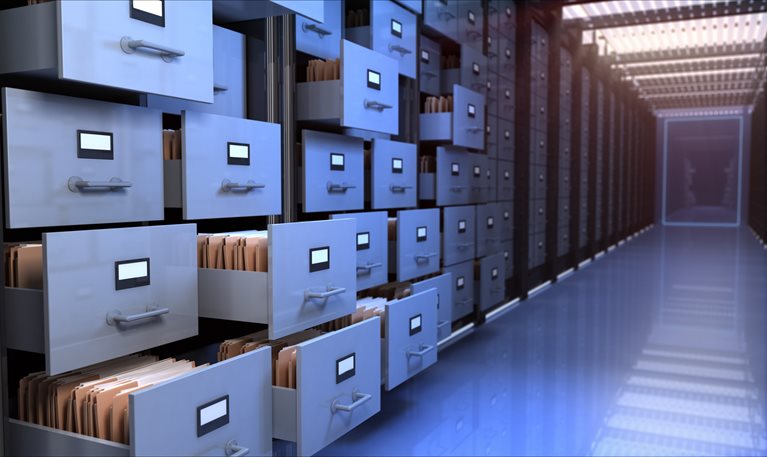
Trusted document storage: more than just a place for files
A modern document storage system is more than just an archive. It integrates documents with corporate systems, roles, and workflows, creating a secure and auditable source of truth that ensures clear control and legal certainty.

Published since: 10. 03. 2026
Why "merely storing" documents is insufficient
Just a few years ago, it was sufficient for documents to be "stored somewhere." A shared drive, network folder, or team workspace met the basic need—documents could be found and opened. However, with increasing digitalization, automation, and regulations, the role of documents has fundamentally changed.
Today, documents enter directly into corporate processes. They serve as the foundation for approvals, decision-making, invoicing, audits, and legal actions. Simultaneously, they are subject to stricter requirements regarding security, traceability, integrity, and access control. In this context, it is no longer enough to know where a document is located; it is crucial to ensure that it is correct, up-to-date, immutable, and verifiable at any time.
This is precisely where the need for a trusted document repository arises. Not as just another technical solution, but as a solid foundation upon which companies can build their digital processes, automation, and data management.
Today, documents enter directly into corporate processes. They serve as the foundation for approvals, decision-making, invoicing, audits, and legal actions. Simultaneously, they are subject to stricter requirements regarding security, traceability, integrity, and access control. In this context, it is no longer enough to know where a document is located; it is crucial to ensure that it is correct, up-to-date, immutable, and verifiable at any time.
This is precisely where the need for a trusted document repository arises. Not as just another technical solution, but as a solid foundation upon which companies can build their digital processes, automation, and data management.
What is a trusted document repository?
A trusted document repository is not merely a place where documents are stored after work is completed. It is a centralized environment that ensures documents remain under control throughout their entire lifecycle—from creation, through approval and usage, to archiving or disposal.
The fundamental difference compared to a standard repository lies in the fact that a trusted document repository works with context. It does not only handle the file itself but also its metadata, links to processes, user roles, and change history. Consequently, it is always possible to demonstrate who worked with the document, what state it was in, and based on which rules it was used.
In this concept, trustworthiness does not stem from a single technical element, but from a combination of several principles. A document must be protected against unauthorized changes, it must be uniquely identifiable and traceable, and its history must be transparent and auditable. Equally important is access control; each user sees and edits only what they are authorized to, in accordance with their role and responsibility.
In practice, a trusted document repository thus becomes the single source of truth for the entire organization. It eliminates parallel document versions and ambiguity regarding validity, ensuring that documents can safely enter other systems and processes—ranging from accounting and procurement to contract management or internal directives.
The fundamental difference compared to a standard repository lies in the fact that a trusted document repository works with context. It does not only handle the file itself but also its metadata, links to processes, user roles, and change history. Consequently, it is always possible to demonstrate who worked with the document, what state it was in, and based on which rules it was used.
In this concept, trustworthiness does not stem from a single technical element, but from a combination of several principles. A document must be protected against unauthorized changes, it must be uniquely identifiable and traceable, and its history must be transparent and auditable. Equally important is access control; each user sees and edits only what they are authorized to, in accordance with their role and responsibility.
In practice, a trusted document repository thus becomes the single source of truth for the entire organization. It eliminates parallel document versions and ambiguity regarding validity, ensuring that documents can safely enter other systems and processes—ranging from accounting and procurement to contract management or internal directives.
What technologies can a document store be based on?
A trusted document repository is not tied to a single specific technology. Its implementation always depends on the size of the organization, the level of regulation, and the other systems that comprise the corporate ecosystem.
In the environment of small and medium-sized enterprises, the Microsoft platform—typically in combination with Microsoft 365 and SharePoint—can serve as a suitable foundation. Such a solution allows for the centralization of documents, access management, and the integration of document workflows with standard office tools.
Conversely, in larger organizations and regulated industries, enterprise content management platforms are often deployed. These are capable of handling complex processes, high volumes of documents, and stringent requirements for auditing and data integrity. Solutions built on technologies such as OpenText, Newgen, or IBM fall into this category.
The critical factor is not the technological solution itself, but rather its ability to integrate seamlessly into existing processes and systems—ranging from ERP, financial, and HR agendas to contract management and other core business processes.
In the environment of small and medium-sized enterprises, the Microsoft platform—typically in combination with Microsoft 365 and SharePoint—can serve as a suitable foundation. Such a solution allows for the centralization of documents, access management, and the integration of document workflows with standard office tools.
Conversely, in larger organizations and regulated industries, enterprise content management platforms are often deployed. These are capable of handling complex processes, high volumes of documents, and stringent requirements for auditing and data integrity. Solutions built on technologies such as OpenText, Newgen, or IBM fall into this category.
The critical factor is not the technological solution itself, but rather its ability to integrate seamlessly into existing processes and systems—ranging from ERP, financial, and HR agendas to contract management and other core business processes.
When is a simple solution insufficient?
Simpler approaches to document storage may be effective when document volumes are low and their role in business processes is primarily supportive. However, as documents accumulate and enter core agendas—such as contracts, accounting records, or HR documentation—and higher demands are placed on them regarding control and accountability, the limitations of these solutions quickly become apparent.
The first indicator is typically the volume of documents. A growing number of files and versions increases the requirements for clarity, traceability, and access management. Without clear rules and structure, parallel copies emerge, uncertainty regarding validity arises, and unnecessary delays occur when searching for the correct materials. Another factor is regulation and internal policies. The moment it becomes necessary to demonstrate how documents are handled, their immutability, or compliance with approval workflows, simple storage is no longer sufficient. It lacks context, history, and the assurance that a document has not been tampered with.
This is closely linked to auditing. Inspections, whether internal or external, require rapid orientation within documents, an overview of changes, and the ability to prove who interacted with a document and at what time. Solutions lacking an audit trail often fail in these situations. Integration with other systems also plays a significant role. Once documents need to function reliably in conjunction with financial, personnel, or other enterprise systems, the repository must provide a stable and controlled foundation that these systems can rely on. It is in these scenarios that the difference between mere document storage and a trusted document repository—capable of supporting organizational operations long-term without unnecessary risk or improvisation—becomes clear.
The first indicator is typically the volume of documents. A growing number of files and versions increases the requirements for clarity, traceability, and access management. Without clear rules and structure, parallel copies emerge, uncertainty regarding validity arises, and unnecessary delays occur when searching for the correct materials. Another factor is regulation and internal policies. The moment it becomes necessary to demonstrate how documents are handled, their immutability, or compliance with approval workflows, simple storage is no longer sufficient. It lacks context, history, and the assurance that a document has not been tampered with.
This is closely linked to auditing. Inspections, whether internal or external, require rapid orientation within documents, an overview of changes, and the ability to prove who interacted with a document and at what time. Solutions lacking an audit trail often fail in these situations. Integration with other systems also plays a significant role. Once documents need to function reliably in conjunction with financial, personnel, or other enterprise systems, the repository must provide a stable and controlled foundation that these systems can rely on. It is in these scenarios that the difference between mere document storage and a trusted document repository—capable of supporting organizational operations long-term without unnecessary risk or improvisation—becomes clear.

FAQ:
DO NOT HESITATE TO
CONTACT US
Are you interested in more information or an offer for your specific situation?
-
 Aricoma joins McLaren Racing’s World Endurance Championship programme
-
 Dynamics 365 Business Central extension modules and applications
-
 Patient data security: Olomouc Hospital has implemented intelligent network traffic monitoring
-
 Why enterprises fail to achieve expected ROI from AI
-
 AI data extraction directly on your infrastructure: Documents that must not go to the cloud
-
 Aricoma Acquires Swiss Company Dentsu Tracking
-
 Digitalizing Contract Management at US Methanol
-
 DocumentExtract: AI solution for automatic document data extraction
-
 How to Manage Contracts in a Company: Contract Lifecycle Management Step by Step
-
 Complaints as a Moment of Truth: Customers Forgive Mistakes, Not Chaos
-
 Why is effective document management key to your company's success?
-
 Securing Luxury Breitling Assets with Blockchain
-
 Outsmarting Illicit Trade with Digital Tracking for European Commission
-
 Aricoma acquires SAP suppliers in Austria and Slovenia
-
 Aricoma unites SAP companies into a single team
-
 B:TECH modernizes business agendas and improves HR and other internal processes
-
 Aricoma renews major contract with the European Commission worth EUR 616.8 million
-
 New IT infrastructure with IBM technologies for Prachatice Hospital with maximum performance
-
 Wolters Packaging Czech streamlines operations and grows with Microsoft Dynamics 365 Business Centra
-
 Unified invoice process for all Zentiva markets with Vendor Invoice Management
-
New IT infrastructure with DELL technologies for Prachatice Hospital with maximum performance
KEEP IN TOUCH
Subscribe to our newsletters so you don't miss anything important.