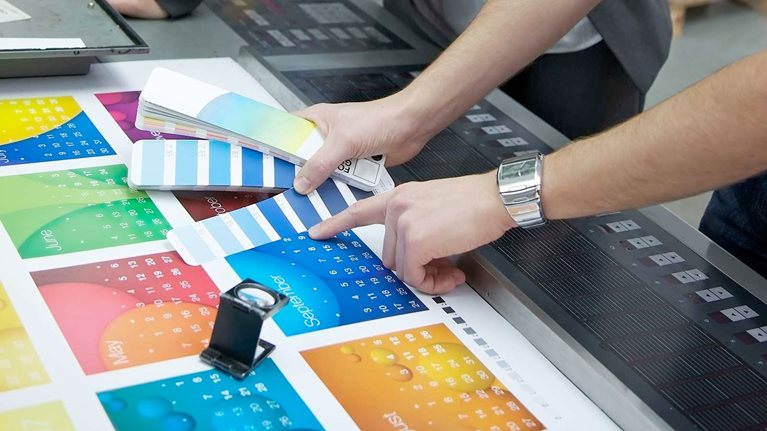
ERP for Printers and Packaging Manufacturers: How to Gain Control Over Every Job
The job is printed and delivered. But was it truly profitable? A modern ERP for printing integrates job estimating, production planning, materials, finance, and post-calculation into a single process.

Why Standard ERP Often Falls Short for Printing Companies
At first glance, it might seem that a printing company needs the same ERP as any other manufacturing enterprise. However, as soon as you dive into estimating, production planning, or managing individual job orders, specific requirements emerge that standard ERP solutions often fail to address.
Print manufacturing is job-based, with nearly every order being unique. They differ in materials used, machinery, lead times, and routing steps. As a result, many printing companies use auxiliary spreadsheets or specialized niche applications alongside their ERP, which complicates data sharing and overall corporate management.
That is why specialized ERP and MIS solutions for the graphics industry exist—such as PrintVis, which extends Microsoft Dynamics 365 Business Central with features designed specifically for printers. What capabilities should a modern information system offer, and how should you evaluate your options?
Print manufacturing is job-based, with nearly every order being unique. They differ in materials used, machinery, lead times, and routing steps. As a result, many printing companies use auxiliary spreadsheets or specialized niche applications alongside their ERP, which complicates data sharing and overall corporate management.
That is why specialized ERP and MIS solutions for the graphics industry exist—such as PrintVis, which extends Microsoft Dynamics 365 Business Central with features designed specifically for printers. What capabilities should a modern information system offer, and how should you evaluate your options?
"In discussions with printing companies, it often turns out that their biggest problem isn’t the information system itself, but the attempt to force industry-specific processes into a generic ERP. From our experience, companies achieve far better results when they choose an ERP platform complemented by a specialized solution designed directly for print manufacturing."
What a Modern Print ERP System Should Deliver
Selecting an ERP system shouldn't begin with a feature checklist, but with the question of which processes the solution needs to cover. The goal isn't just to acquire another software package, but to connect sales, production, logistics, and finance so that everyone operates on a single source of truth, and management maintains real-time visibility into company operations at all times.
A modern print ERP should handle the entire job life cycle—from initial inquiry and estimating through production scheduling to shipping, invoicing, and actual cost tracking. Connecting these individual processes yields the greatest time savings and minimizes errors caused by manual data re-entry.
System openness is equally critical. The ERP must be ready to integrate with e-commerce portals, CRM platforms, shop-floor machinery, or reporting and data analytics tools. This ensures the company won't need to replace its entire information system whenever a new requirement arises in the future.
A modern print ERP should handle the entire job life cycle—from initial inquiry and estimating through production scheduling to shipping, invoicing, and actual cost tracking. Connecting these individual processes yields the greatest time savings and minimizes errors caused by manual data re-entry.
System openness is equally critical. The ERP must be ready to integrate with e-commerce portals, CRM platforms, shop-floor machinery, or reporting and data analytics tools. This ensures the company won't need to replace its entire information system whenever a new requirement arises in the future.
5 Signs Your Printing Company Has Outgrown Its Current ERP
An information system rarely needs replacing simply because it is old. Rather, it happens because it has stopped keeping pace with company growth. Order volume increases, production becomes more complex, and employees start relying on spreadsheets, manual logs, or disparate apps. If you recognize any of the following signs, it is likely time to consider a more modern solution.
How to Choose an ERP for the Printing Industry
Choosing an ERP for the printing industry is a strategic decision that will shape your business operations for years to come. Therefore, it is not merely a matter of comparing features or pricing. The first step should be an analysis of your current processes and a clear identification of the areas the new system needs to improve. Understanding your own needs is the foundation of a successful project. The biggest mistake isn't choosing the wrong ERP. The biggest mistake is starting the selection process before you know exactly what problems the new system needs to solve.
Only then does it make sense to compare individual solutions. Beyond functional scope, you should evaluate integration capabilities, user friendliness, future platform development, and the implementation partner’s track record in the printing sector. It is equally important to request live demonstrations based on realistic scenarios from your shop floor—such as generating a complex estimate, scheduling production, or running a post-calculation profitability report. These real-world tests best reveal whether a solution fits your plant's specific needs.
Only then does it make sense to compare individual solutions. Beyond functional scope, you should evaluate integration capabilities, user friendliness, future platform development, and the implementation partner’s track record in the printing sector. It is equally important to request live demonstrations based on realistic scenarios from your shop floor—such as generating a complex estimate, scheduling production, or running a post-calculation profitability report. These real-world tests best reveal whether a solution fits your plant's specific needs.
What to Look Out for When Selecting a Print ERP
When evaluating ERP systems, companies often focus heavily on price or the length of the feature list. In reality, project success is driven by other factors. What matters most is whether the system aligns with how your printing business actually works, supports your core processes, and can adapt in the coming years. An equally crucial role is played by the implementation partner, who must understand not only the underlying technology, but also the nuances of print production.
Another common mistake is trying to bend company processes to fit the limitations of a rigid system—or conversely, demanding extensive custom modifications where proven industry standards already exist. Both approaches typically lead to overly complex implementations, inflated costs, and difficult upgrades down the road. A modern ERP should offer sufficient flexibility while building upon validated workflows that help companies operate more efficiently.
Choosing an ERP is not just a decision about software. It is an investment in how your company will manage orders, schedule production, and leverage data for years to come. It pays to dedicate sufficient time to both preparation and solution selection.
Another common mistake is trying to bend company processes to fit the limitations of a rigid system—or conversely, demanding extensive custom modifications where proven industry standards already exist. Both approaches typically lead to overly complex implementations, inflated costs, and difficult upgrades down the road. A modern ERP should offer sufficient flexibility while building upon validated workflows that help companies operate more efficiently.
Choosing an ERP is not just a decision about software. It is an investment in how your company will manage orders, schedule production, and leverage data for years to come. It pays to dedicate sufficient time to both preparation and solution selection.
How to Know You’ve Chosen the Right Information System
You won't recognize the right ERP by its long list of features, but by the fact that it becomes a seamless part of daily operations. Sales reps build quotes faster, production schedules from a single interface, management accesses real-time data, and employees no longer re-enter information across disconnected apps. Instead of hunting down accurate data, your team can focus on value-generating tasks.
Furthermore, the benefits of a well-chosen ERP extend far beyond individual departments. Connecting sales, production, logistics, and finance gives leadership full visibility into jobs, actual costs, and plant utilization. Decision-making becomes faster, more precise, and grounded in real-time data rather than estimates or manually prepared spreadsheets.
A well-selected ERP is more than just an operational control tool for today. It provides the foundation for your company's future growth. It allows you to easily expand functionality, integrate new applications, automate routine workflows, and leverage modern technologies such as business intelligence or artificial intelligence—supporting business expansion for years after implementation.
Furthermore, the benefits of a well-chosen ERP extend far beyond individual departments. Connecting sales, production, logistics, and finance gives leadership full visibility into jobs, actual costs, and plant utilization. Decision-making becomes faster, more precise, and grounded in real-time data rather than estimates or manually prepared spreadsheets.
A well-selected ERP is more than just an operational control tool for today. It provides the foundation for your company's future growth. It allows you to easily expand functionality, integrate new applications, automate routine workflows, and leverage modern technologies such as business intelligence or artificial intelligence—supporting business expansion for years after implementation.
FAQ / Frequently Asked Questions
ERP for the printing industry?
Every printing plant has different processes and priorities. Schedule a non-binding consultation with our specialists, and together we will evaluate which solution will best meet your needs.
-
 AISIN: Digitization of Accounts Payable Invoice Approval in Microsoft 365 Integrated with SAP
-
 PPWR and Packaging Data in Dynamics 365: Planning vs. Shipping
-
 PPWR in ERP: Do You Know What Packaging Actually Leaves with Each Customer Order?
-
 SharePoint Modernization as a Foundation for Further Development at Mlékárna Hlinsko
-
 Business in the Age of AI
-
 Don't repeat mistakes already made by others: 5 most common problems when implementing AI
-
 Document Archiving as the Foundation of Company Management: How to Choose the Right Approach
-
 How to Manage Contracts in a Company: Contract Lifecycle Management Step by Step
-
 Model Context Protocol (MCP): The New Standard for Connecting AI and ERP
-
 AI Assistant vs. AI Agent: What Is the Difference and How to Get Started with AI in Your Company
-
 AI in ERP: How AI is Transforming Enterprise Resource Management
-
 E-Invoicing Without Delay: Belgium and France Transition to New Standards
-
 History of Dynamics 365: From Axapta to Microsoft Dynamics 365 Finance and Supply Chain Management
-
 Licensing changes in Dynamics 365 Finance and Supply Chain Management - do not uderestimate them!
-
 Why You Need a DMS Even If You Use Microsoft Dynamics 365: A Comprehensive Approach to DMS
-
 5 challenges for current ERP system in food industry
-
 Innovation, automation, efficiency: the Emco success story with Microsoft Dynamics 365
-
 Artificial intelligence in business and marketing: How Copilot can help you
-
 How to avoid disaster when implementing an ERP system
-
 HB Reavis, international workspace provider, uses Dynamics 365 Finance
-
 Are Business Central reports not enough for your needs? Connect your data to Power BI
-
 Document Automation in Business Central: From EDI to AI Extraction
KEEP IN TOUCH
Subscribe to our newsletters so you don't miss anything important.