aricoma logo avatar

#1 in Enterprise IT

AI in ERP: How AI is Transforming Enterprise Resource Management hero image

AI in ERP: How AI is Transforming Enterprise Resource Management

Artificial Intelligence is becoming a standard component of modern ERP systems. How does it impact finance, supply chain, and project management? We present specific scenarios and their impact on corporate performance. aricoma avatar

How Artificial Intelligence is Transforming Modern ERP Systems

Enterprise information systems are undergoing their most significant transformation in the last twenty years. What once represented the mere digitalization of processes now signifies intelligent, real-time business management. Artificial Intelligence serves as the primary catalyst for this shift. According to the AI Momentum 2026 survey conducted by the Czech Association of Artificial Intelligence and the Czech Chamber of Commerce, approximately half of Czech companies are already actively using or testing AI, with an additional 40% planning its implementation. Consequently, nearly 90% of enterprises are strategically accounting for AI, though most remain in the pilot project phase. The true benefits will materialize only when AI becomes integrated into core processes, particularly in finance, supply chain management, and project management.

The synergy between Artificial Intelligence and information systems is best demonstrated by the AI-powered ERP platform Microsoft Dynamics 365, which has evolved in recent years from a cloud-based system into an agentic, AI-driven operating environment. Where, then, does AI in ERP deliver genuine value today?
We will focus on key areas:

This is not about technological hype. It is about the practical impact of AI-native ERP on performance, efficiency, and management decision-making.

Discover how artificial intelligence within information systems can enhance cash flow predictability, supply chain efficiency, and project profitability.

AI in Finance: From Accounting Automation to Predictive Cash Flow

Within Dynamics 365 Finance, AI is becoming an inherent component of financial management. As the most structured area of ERP, finance enables the rapid deployment of intelligent features with a measurable impact on accuracy, speed, and risk management.

Intelligent Automation of Financial Processes

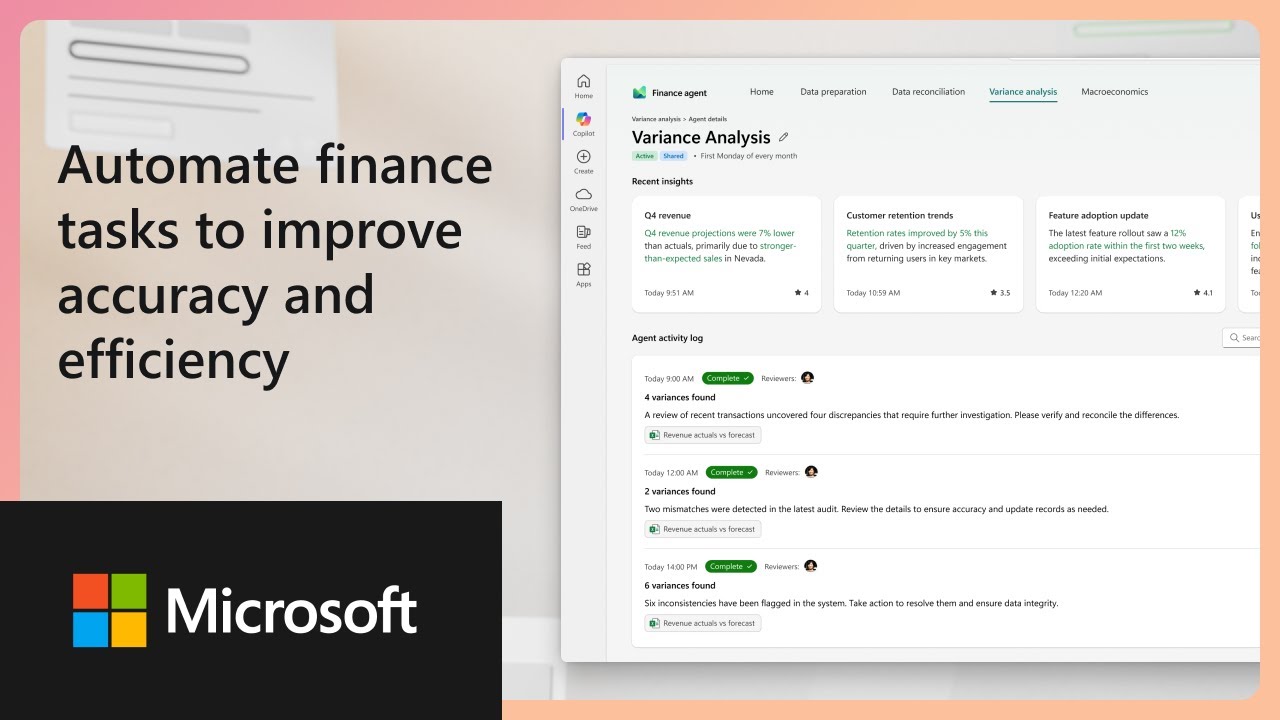
AI automates invoice matching, document processing, expense classification, and anomaly detection in accounting entries. This results in faster case closures, lower error rates, and higher data transparency.

It is not merely about time savings, but about more stable and controlled financial processes that establish a high-quality foundation for further analytics.

Predictive Liquidity Management and Risk Management

Predictive models analyze customer payment behavior and historical data to refine cash flow forecasting. This provides the CFO with a tool for proactive liquidity and working capital management, rather than relying solely on retrospective reporting.

Dynamics 365 AI thus helps identify high-risk receivables or expected collection fluctuations in a timely manner, allowing for a response before the issue impacts financial performance.

Recommendation Models and Autonomous Finance

Advanced scenarios go beyond mere prediction. The system can suggest specific measures—adjusting credit limits, prioritizing debt collection, or modifying payment terms.

Finance is thus shifting from an administrative function to active risk and capital management. In this capacity, AI supports management decision-making and increases the predictability of the entire company's financial performance.

youtube video thumbnail

Gain control over your cash flow with AI in ERP. Let’s discuss the possibilities of integrating artificial intelligence into your financial management.

AI in Supply Chain Management: Demand Forecasting and Supply Chain Resilience

Within Dynamics 365 Supply Chain Management, AI integrates planning, production, warehousing, and logistics into a single data framework. The objective is not only higher forecasting accuracy but also increased resilience and improved working capital management.

AI Forecasting and Production Planning

AI models refine demand forecasting based on historical data, seasonality, and current trends. More accurate forecasting results in a more stable production plan, fewer urgent interventions, and optimized capacity utilization.

The outcome is a reduction in variability and increased reliability in customer deliveries.

Optimization of Inventory and Capital

The system evaluates optimal inventory levels considering demand, lead times, and the risk of shortages. AI helps reduce overstocking and the risk of stock-out situations, which has a direct impact on cash flow and inventory turnover.

Dynamics 365 Supply Chain Management thus becomes a capital management tool rather than a purely operational function.

Scenario Simulations and Risk Management

Advanced features enable simulations of the impacts of supplier outages, changes in input prices, or logistical constraints. Management gains the ability to model scenarios and prepare responses before a problem arises. In this capacity, AI supports the COO's strategic decision-making and increases the resilience of the entire supply chain.

youtube video thumbnail

Optimize your supply chain with AI in Dynamics 365. Let us design an AI strategy for your processes.

AI in Project Operations: Managing Margins, Capacity, and Project Risks

Within the environment of Dynamics 365 Project Operations, AI helps manage projects based on data rather than intuition. The key objective is higher margin predictability and better resource utilization.

Predicting Project Profitability

Based on historical project data, the system identifies patterns leading to budget overruns or schedule slippage. Early warnings allow for intervention while the project is still in progress.

Management thus gains a tool for ongoing profitability management, rather than just a final post-project evaluation.

Intelligent Resource Allocation

AI analyzes the availability, competencies, and historical performance of teams to recommend the optimal allocation of capacities. This leads to better resource utilization and higher project margins.

Capacity planning thus becomes a data-driven process.

Real-time Project Variance Management

The system continuously evaluates variances between the plan and reality and alerts to high-risk projects. This increases transparency and enables faster managerial decisions.

AI reduces the likelihood of "unpleasant surprises" at the end of the project.

youtube video thumbnail

Manage project margins based on data, not intuition. Find out with us how to leverage AI in project management.

AI Agents and Copilot in ERP: From User Support to Autonomous Processes

AI assistants integrated into Microsoft Dynamics 365 simplify data handling and accelerate management decision-making.

The Role of AI Assistants in Management Decision-Making

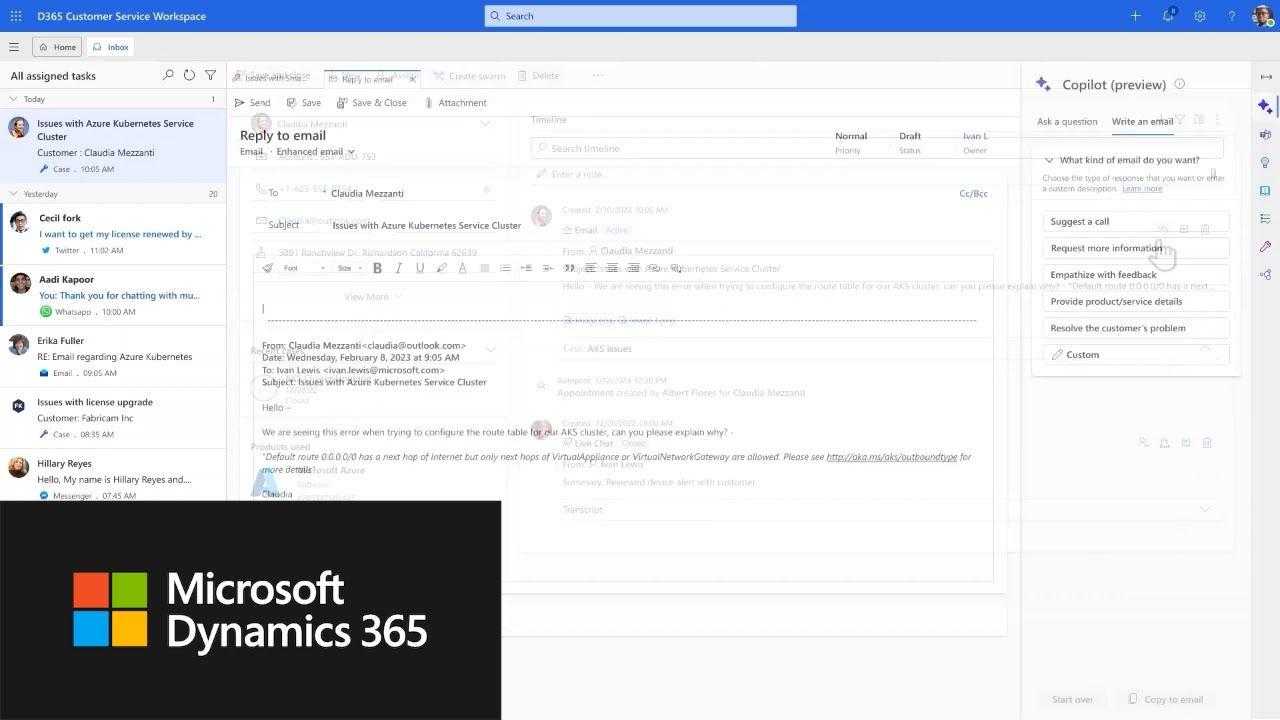
Copilot enables working with ERP data using natural language. A manager can quickly gain an overview of cash-flow trends, inventory turnover, or project margins without the need for complex reporting.

This shortens the time between the question and the decision.

Autonomous Agents in ERP Workflow

Advanced scenarios include autonomous agents that monitor processes in finance, procurement, and projects and initiate steps themselves—for example, by flagging a risky receivable or an unfavorable purchase price.

Using Microsoft Copilot Studio, these agents can be created and managed over Microsoft Dynamics 365 data without complex development. Unlike traditional automation, they work with context and prediction, rather than just fixed rules.

youtube video thumbnail

Do not hesitate to utilize Copilot and Copilot Studio in Microsoft Dynamics 365 and take your ERP further through AI agents and automation.

Read more about the capabilities of Microsoft Copilot

Microsoft Power Platform extends ERP capabilities without the need for intensive custom development. It enables the rapid creation of applications, automations, and custom AI scenarios based on ERP data.

Low-code Process Automation

Using workflow tools, it is possible to automate approvals, notifications, or internal processes without interfering with the ERP core. This accelerates innovation and reduces dependence on development.

Custom AI Models Over ERP Data

Companies can create their own predictive models or analytical applications based on financial, manufacturing, or project data. The ERP thus becomes the central data source for broader AI initiatives.

Governance and Architecture of AI Solutions

As the number of AI projects grows, so does the need for clear architecture and governance. A platform-based approach allows for the consolidation of AI capabilities within a single ecosystem and minimizes integration risks.

ERP with AI thus stops being a collection of isolated experiments and becomes a managed component of the company's digital strategy.

Power apps

Automate your ERP processes using AI agents. Discover the possibilities of implementing agentic AI into your business processes.

ERP with AI as the New Standard for Corporate Management

Data from the AI Momentum 2026 survey show that 78% of Czech companies plan to launch a new AI project. Their approach is soberly optimistic; they want to invest, but at the same time, they are aware of the technological and organizational risks.

The key question, therefore, is not whether to use artificial intelligence, but whether it will remain an isolated experiment or become a solid part of an AI ERP strategy.

An autonomous enterprise is not created by implementing a single tool, but by the systematic integration of AI into all business processes. ERP transformation with AI is not a system upgrade, but a change in the company's operating model. Finance becomes predictive, the supply chain becomes adaptive, and project management becomes data-driven. 2026 could be the tipping point when ERP with AI becomes the new standard for corporate management.

Dynamics 365 Finance
Dynamics 365 Supply Chain Management

We are your strategic partner for AI and ERP

If you are looking for a partner capable of connecting strategy, process change, and the technological implementation of Microsoft Dynamics 365, you need a team that understands not only the system but also the operations of large enterprises.

For your projects, we combine the experience of consultants, architects, and developers with deep knowledge of business processes, financial management, manufacturing, and project-based organizations.

We help companies set up ERP architecture, AI governance, and specific use-case scenarios so that technology delivers a measurable impact on the company's performance and stability. If you want to move your ERP from digitalization to autonomous management, we are ready to be your long-term partner.

František Kulvajt

Sales Director

FAQ:

What is D365 (Dynamics 365)?

D365 is an abbreviation for Microsoft Dynamics 365 (formerly Axapta), a cloud-based ERP and CRM platform that integrates finance, procurement and supply chain processes, manufacturing, projects, and sales into a single data environment. Dynamics 365 enables the use of AI, automation, and analytics directly within the core of the ERP system.

What is the distinction between a traditional ERP system and an AI-enhanced ERP?

Traditional ERP systems operate primarily with historical data and reporting. AI-driven ERP, such as Microsoft Dynamics 365, incorporates predictive modeling, workflow automation, and AI agents that facilitate real-time cash flow management, inventory optimization, and project risk mitigation.

How does AI enhance supply chain relationships?

AI within Dynamics 365 Supply Chain Management improves demand forecasting accuracy, optimizes inventory levels, and enables the simulation of supply chain risks. This results in cost reductions, enhanced product availability, and more efficient capital management.

When is it strategically viable to initiate an AI-driven ERP transformation?

The optimal time is when an organization is modernizing its ERP system or seeking to increase productivity without escalating costs. An AI-driven ERP transformation delivers the greatest value when it is integrated into a strategic shift of the operating model.

How is compliance and regulation ensured when using AI in ERP?

Compliance is not just a matter of technology, but also of properly setting up governance and processes. For example, Microsoft Dynamics 365 runs on the Azure platform, which meets a wide range of international security and regulatory standards (e.g., ISO, SOC, GDPR). However, a crucial role is played by AI governance—clearly defined rules for data handling, audit trails, access rights management, and the transparency of decision-making mechanisms. This ensures that AI ERP can be used in accordance with both internal directives and external regulatory requirements.

What is AI in an ERP system?

AI in ERP signifies the utilization of artificial intelligence directly within the enterprise information system. Typically, it includes predictive cash-flow, demand forecasting, risk detection, AI agents, and recommendation models that improve management decision-making in the areas of finance, manufacturing, and project management.

How does AI in Dynamics 365 empower the CFO?

AI within Dynamics 365 Finance enables predictive cash flow management, detection of high-risk receivables, and the automation of accounting processes. The CFO gains enhanced control over working capital, more accurate forecasting, and support for strategic decision-making.

Is AI within ERP secure from a data and regulatory perspective?

Yes, when implemented correctly. Microsoft Dynamics 365 adheres to enterprise-grade security and compliance standards. However, robust AI governance, solution architecture, and access rights management remain critical.

How is AI implementation conducted within Microsoft Dynamics 365?

The implementation of AI within an ERP system involves process analysis, the definition of use-case scenarios, architectural design (including Power Platform), pilot projects, and a phased rollout across key functional areas such as finance, supply chain, and project management.

Is AI in ERP secure?

Yes, if it is built on secure, ideally native technology of the given platform. For example, in the case of Microsoft Dynamics 365, AI (including Copilot) is a natural part of the Microsoft ecosystem and respects existing security models, roles, and permissions within M365 and Azure. Data remains within the organization's tenant environment, is not used to train public models, and is protected by encryption, identity management (Microsoft Entra ID), and centralized access control.

Share

CHCETE VĚDĚT VÍCE O AI VE VAŠEM ERP?

Neváhejte nás kontaktovat. Navrhneme vám konkrétní scénář využití AI a automatizace v ERP Microsoft Dynamics 365, s jasnými přínosy.

By submitting the form, I declare that I have familiarized myself with the information on the processing of personal data in ARICOMA.

KEEP IN TOUCH

Subscribe to our newsletters so you don't miss anything important.

By entering your e-mail, you agree to the terms of personal data protection.